



2025 Event Rules & Guidelines
TEAMS
- Each team will consist of four anglers. An alternate angler may substitute on a daily basis.
- Only one member of a team may be a professional full-time or part-time fresh or saltwater fly fishing guide. A participant will be deemed to be a professional (or “Pro”) if they meet any of the following criteria within the last 10 years:
- They have been a full or part-time fresh or salt water Fly Fishing Guide or Captain who has received income for guide service performed as Guide or Captain.
- They have been designated as a “Pro Staff” member, “Ambassador” or equivalent title/term for a fly fishing branded products company AND have received cash remuneration from that company as a result
- They have been a member of, or participant on, a national fly fishing team (such as the US Fly Fishing team).
- Each team member and fishing guide is responsible for reading and understanding these rules. If there are questions, please contact a One Fly Board or staff member immediately.
EQUIPMENT
- Anglers may bring one or two fly rods and reels of their choice.
- Only floating fly lines are permitted. Sinking leaders of seven feet or less are permitted. Steel leaders are not permitted.
- No fish attractants, such as scents, are permitted.
EVENT FLIES
- Anglers will choose the fly they will use each day though they may ask the advice of the guide when choosing the fly. A different fly and a different pattern may be used on each day of the event.
- Flies must be tied on a single barbless hook, or on a hook with the barb pushed down. The event fly may be no larger in hook gap, nor longer in shank length, than the template shown below: Size of hook may be no larger than image shown. Image based on Tiemco 5263 size 6 with 3x shank.
- The fly may have one set of dumbbell eyes (up to size medium), one bead, or one cone head. Lead or non-lead wire may be used in the construction of the fly. Non-lead weight may be added to the leader. Appendages that alter the profile of an artificial fly, or bodies or heads made of molded or shaped plastic, silicone, rubber or metal are not permitted (examples are molded or shaped imitation worms, eggs, baitfish, maggots, twisters or the like). Rubber legs are acceptable but other types of extruded rubber materials (such as might be used in a fly body or tail) are not acceptable. Spinner blades, rattles and swivels are prohibited.
- Angler must declare his/her fly and the guide must approve the angler’s fly selection by 8:30am or when the boat launches, whichever is earlier. If the guide approves an illegal fly, the angler and guide are equally responsible for its use and no points will be awarded for fish caught that day on that fly. Conversely, if the guide questions the legality of the chosen fly, the guide must inform the contestant of such. The contestant must then present that fly to a One Fly Board member, or other staff member after fishing ends that day.
- Strike indicators may be no larger than 3/4 inch in any dimension. Flies, even those with broken hooks, are not allowed to be used as an indicator.
- Repair of flies may be done only with the use of adhesive and the material that originally came on the fly. Any re-tying of the fly with thread or fly-tying materials is prohibited. Broken hooks may be re-sharpened.
FISHING PROCEDURE
- Federal and state rules and regulations governing the waters to be fished will be strictly observed. Anglers and guides must abide by all Wyoming and Idaho Game and Fish regulations concerning fishing, aquatic invasive species and boating.
- AIS INSPECTION REQUIREMENTS:
- All watercraft entering Wyoming are required to undergo a mandatory inspection by an authorized inspector prior to launching
- All watercraft launching in Wyoming are required to possess a valid AIS decal.
- Any participant found to violate State Game and Fish, or National Park regulations during the Event fishing hours will be disqualified.
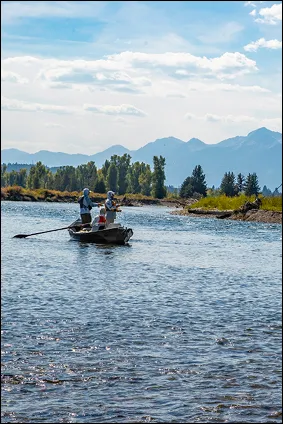
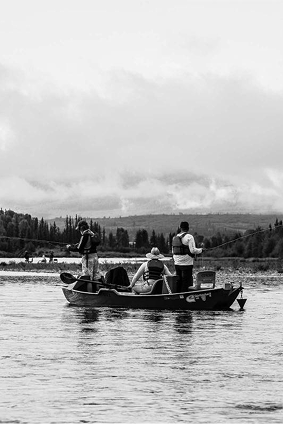
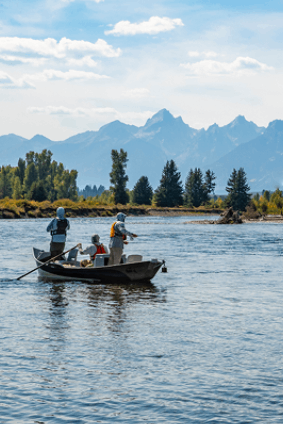
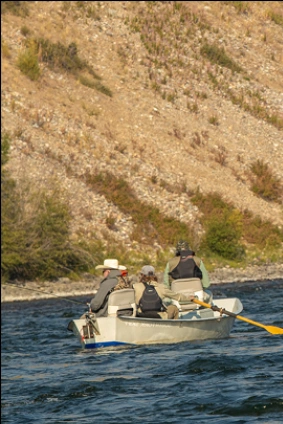
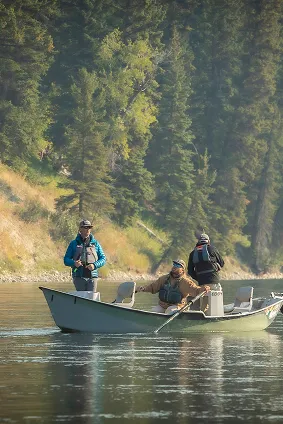
- Two anglers from different teams will fish in each boat.
- All main river channels are fishable.
- Only trout species will be counted in the scoring.
- Fishing hours on the Snake River will be from 8:30am until 4:30pm on day 1, and from 8:30am until 4pm on day 2. Fishing hours on the South Fork River for both days will be from 8:30am until 4pm. Guides are the official time-keepers and should set a phone alarm to signal the start and end of the fishing day. No fishing before 8:30am is permitted, not even with another fly.
- Only legal BLM, Forest Service, National Park, or One Fly-approved river accesses may be used. A list of allowed accesses will be available to guides at their required meeting before the One Fly.
- Anglers may not float through any stretch of water more than once except that a guide may maneuver a boat upstream to fish a particular run again (for example, by back-rowing or walking).
- Use of motors on boats during event hours is prohibited.
- Anglers may not fish upstream from their assigned put-in, with the exception of the South Fork Upper section, and the Dam section of the Snake River (here, GTNP regulations must be followed). Anglers may not fish downstream of a line perpendicular to the section take-out (Dam to Pacific section boundary starts where Pacific Creek meets the Snake).
- The Upper South Fork section will take out at the Spring Creek Bridge. The Middle South Fork section will put in at the Spring Creek Bridge and take out at Eagle. The Lower South Fork section will put in at Eagle and take out at Byington.
- An angler’s assigned fishing venue and guide may not be altered. Unless specifically approved in advance by the Rules Committee, any variance from these assignments will disqualify the angler from that day’s fishing.
- With the permission of the fisherman who has a fish “on the line,” the guide or boat partner may assist in landing any fish to be scored in the event.
- If an angler’s fly becomes caught in brush or a snag, it may be recovered and reattached to the leader. The angler may continue fishing in the event. The angler can be disqualified by the guide for any unsafe practice used to retrieve a fly. Daily scoring ends for the angler when his contest fly becomes irretrievably lost. That person may continue to fish for the remainder of that day, but no fish caught after the contest fly is lost may be scored.
- Each angler should expect to spend half the day in the front of the boat. However, any arrangement regarding boat position the two anglers agree upon is acceptable. Rotation schedule should be decided before the float begins. A fish hooked before the end of fishing time can be fought and measured and counted if the fight goes on past the end of fishing time
- The person in the front of the boat will, within reason, have the choice of boat position, such as right bank vs. left bank, casting distances, or stopping the boat to fish.
- Anglers must wear their life vests, and have all buckles fastened, while fishing or being transported on the river.
- Guides will be furnished daily a Rules Violation Sheet, where the guide will write out any violation, have it signed by a witness (other person in the boat) and should turn the Violation Sheet into the Rules Committee within 2 hours after landing. If the Rules Committee is not physically available, other One Fly Board members, along with a guide representative, may consider the issue at hand. Penalties will vary with the violation and may include but not be limited to nullifying individual scored fish, nullifying daily scores and/or disqualification from the event.
- Trout caught from tributary streams which enter the primary river may be scored if the fly is cast no more than 100 ft. upstream into the tributary from the high mark of the natural stream bed of the main river. Any angler fishing in an area inconsistent with the above will be disqualified from the event.
- Any angler repeatedly showing disrespect of his boat-mate or guide, by action, language, criticism, or materially interfering with the fishing of his boat-mate, shall be warned by the guide of possible disqualification. The guide shall present to the Rules Committee a written summary of the behavior that occurred.
SCORING
- The One Fly scoring procedures are designed to reduce the handling of our trout.
- Each angler will be allowed to select eight (8) trout to measure during the day. Six (6) of these fish will have a bonus score. All trout not selected for measurement will be released immediately, preferably without removing them from the water. The decision to measure a trout must be made before subjecting the fish to an official measurement and, again, only 8 trout can be selected for measurement.
- The GUIDE must measure any and all fish that are selected for measurement in order to determine a bonus score for that fish. For the avoidance of doubt, any fish not measured by the guide will not receive a bonus score.
- To be counted in the score, the release of a caught trout must be witnessed by the guide. Each of these trout will have a value of two points. If the angler or the guide touches the leader while a fish is “on”, then that fish is counted as two points.
- All trout, including foul hooked trout, are counted unless the angler intentionally foul hooks the fish. It is up to the guide to determine if the fish was foul hooked intentionally.
- Measurement of trout shall be done by the guide while the trout is in the water whenever possible. The guide should measure the trout with the fish placed headfirst into the trough provided to the guide, a Fishscale on the rod or net handle, a ruler, tape measure or like device. Fish are to be measured from the tip of the nose to the tip of the relaxed tail. The tail of the trout should not be pinched. All trout should be measured to the nearest 1/4 inch, to ensure accurate measurements for the biggest fish event. Measurements should not be rounded up by the guides. In signing the scorecard, the angler understands that this represents only an estimate of their final score. Scores will be finalized by the scoring committee, due to rounding of fish length and/or incorrect addition of total points.
- A penalty will be assessed for any fish killed or ruled by the guide to be unable to survive. Each of these fish will be measured and the scored value of that trout will be subtracted from the angler’s score. That trout will not be counted against the daily limit of six measured trout.
- Twenty-five points will be awarded for each day that an angler keeps his event fly all day.
- Each of the six fish measured for a bonus score will be awarded points as follows:
Less than 12″ = 2 points | 12″ = 2 points + 10 points
13″ = 2 points + 20 points | 14″ = 2 points + 30 points
15″ = 2 points + 40 points | 16″ = 2 points + 60 points
17″ = 2 points + 80 points | 18″ = 2 points + 100 points
19″ = 2 points + 125 points | 20″ = 2 points + 150 points
21″ = 2 points + 175 points | 22″ = 2 points + 200 pointsBONUS POINTS:: Add 50 points per inch for trout over 22 inches
Other Bonus Points: If total number of trout landed is between…
30-39: Add 50 bonus points
40-49: Add 100 bonus points
50+: Add 150 bonus points